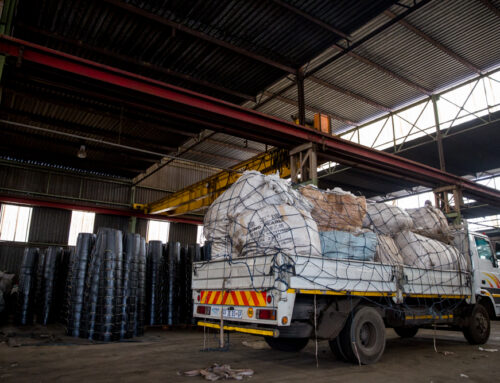
For nearly a decade, the National Cleaner Production Centre South Africa (NCPC-SA) has assisted KwaZulu-Natal (KZN) companies divert waste from landfills, save money and create jobs by implementing an innovative exchange of waste and under-utilised resources.
The NCPC-SA established the KZN Industrial Symbiosis Programme (KISP) in 2014 to promote cleaner production and waste beneficiation within the province. The KISP is a fully funded facilitation service that promotes the exchange of waste and/or under-utilised resources (material, energy, water, waste, assets, logistics, expertise, etc.) of one company with another that can reuse the resource, thus resulting in mutual benefits for all participants.
From 2015 to 2022, the NCPC-SA employed this approach to waste minimisation and diversion, and completed 230 mutually beneficial synergies or exchanges that resulted in:
- 518 000 tonnes of waste diverted from landfills.
- 5 million saved due to landfill diversion, and
- 7 million tonnes in reduction of greenhouse gas emissions.
KZN companies that enter into mutually beneficial synergies decrease CO2 emissions, landfill costs, the use of virgin resources, industrial water usage, hazardous waste, pollution, and transportation costs. They also increase profits, sales, the potential for new business, and job creation.
The NCPC-SA through KISP has assisted companies to divert agri-processing waste, wood or pulp and paper waste resources, as well as chemical and packaging materials. “The impact of the diversions varies but what stands out is that the symbiotic initiatives have a potential to assist companies to create and retain jobs, whilst reducing costs of using virgin materials,” states Pearl Thusi, NCPC-SA Senior Project Coordinator.
A recently established synergy between tunnel vegetable and livestock farmers helped both farming businesses realise tangible financial benefits. The KISP assisted the tunnel vegetable farmer to divert below-market quality crops to a poultry farmer that uses them as feed inputs. The poultry farmer saves on purchasing costs, while the tunnel vegetable farmer saves on landfill disposal costs. To view more industrial symbiosis case studies, visit the NCPC-SA website.
“Prioritising the reduction of waste generation and landfill diversion is not only paramount for environmental sustainability, but viable synergies prove that a circular economy is possible and that tangible benefits are clear,” explains Thusi.
The work that is conducted by KISP dovetails with the Department of Forestry, Fisheries and the Environment’s (DFFE) Industrial Symbiosis Initiative that is implemented in partnership with the NCPC-SA in three regions: Limpopo, Free State, KZN, Northern Cape and Mpumalanga. The collaboration increases the reach and impact of landfill diversions in alignment with the Department of Trade, Industry and Competition’s mandate for a green economy. The DFFE initiative will continue for the next 18 months, during which, scaled outputs and impacts are expected.
The NCPC-SA invites all KZN stakeholders working or wishing to work, in waste minimisation to engage with the programme to help in establishing synergy initiatives effectively and sustainably. “KISP has the potential to change the game as far as waste exchange is concerned,” reveals Thusi.